
The sale price of a business depends on its profitability, growth potential, debt, legal risks, and ability to operate after a change in ownership. An initial valuation helps justify the asking price, identify weaknesses, and prepare for negotiations.
How to value a business
There is no single formula for valuing a business. The final amount depends on the industry, company size, and financial performance. Professional appraisers often use several valuation methods and compare the results. Each method has its advantages and limitations.
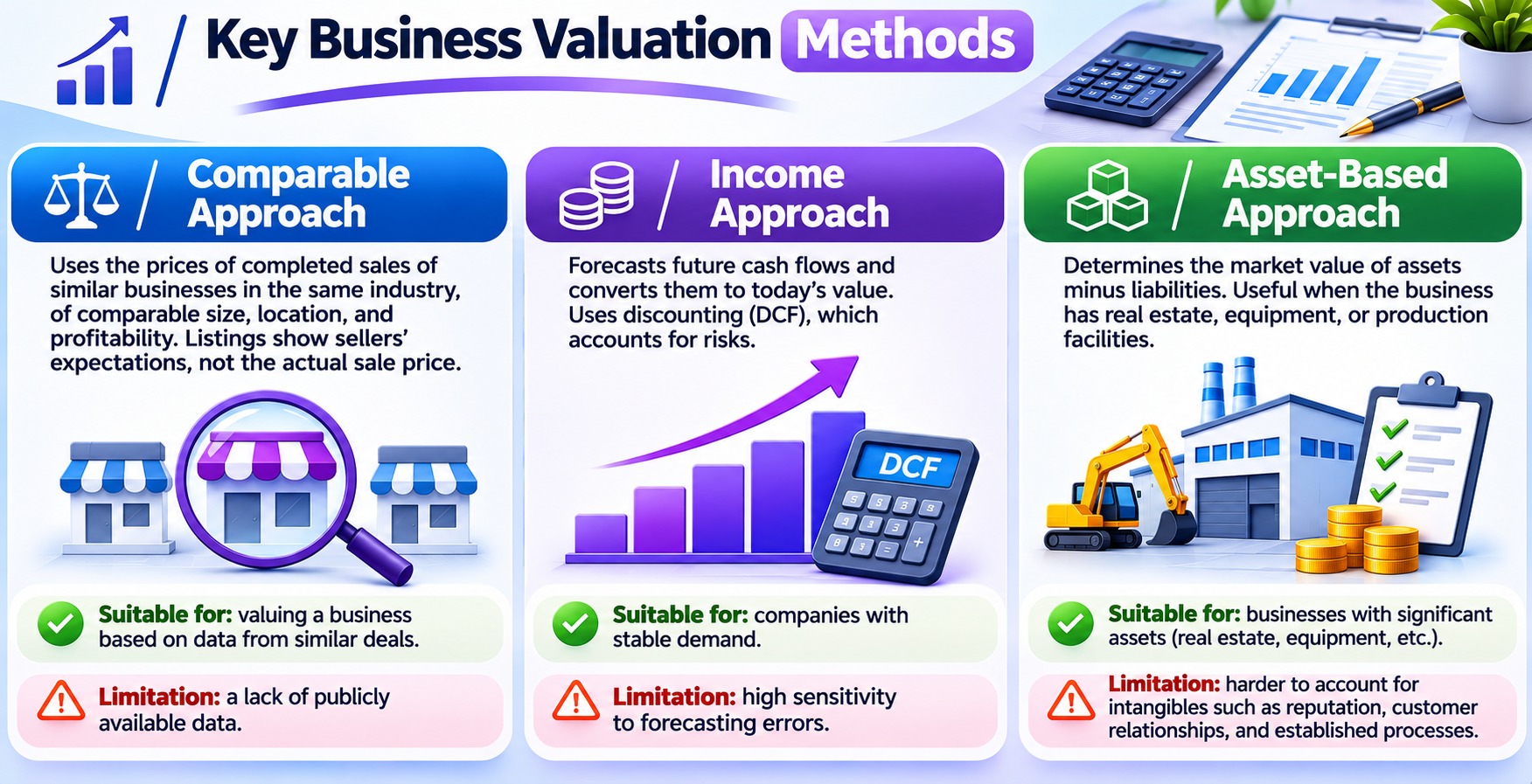
Main valuation methods
- Market approach. This method uses prices from completed sales of similar businesses in the same industry. Company size, location, and profitability are key factors. Listed asking prices reflect seller expectations rather than actual sale prices. The main limitation is the lack of publicly available transaction data.
- Income approach. This method estimates future cash flows and converts them into their present value. Discounted cash flow (DCF) analysis accounts for risk and the time value of money. It works well for businesses with predictable earnings but relies heavily on accurate financial forecasts.
- Asset-based approach. This method calculates the market value of assets minus liabilities. It is useful for businesses that own real estate, equipment, or manufacturing facilities. However, it may not fully capture the value of brand reputation, customer relationships, or established operations.
Using earnings to calculate business value
One common starting point for determining how to value a business for sale is EBITDA, or earnings before interest, taxes, depreciation, and amortization. This metric helps compare the operating performance of different companies. However, it does not replace cash flow analysis. Capital expenditures, changes in working capital, and loan repayments are not reflected in EBITDA.
For smaller, owner-operated businesses, SDE (seller’s discretionary earnings) is another common metric, particularly in the United States. It accounts for owner compensation, certain personal expenses, one-time costs, and other justified adjustments. SDE and EBITDA multiples cannot be compared directly because they use different earnings calculations.
Before applying valuation multiples, financial statements should be reviewed and adjusted. This includes removing one-time income, excluding unusual expenses, and comparing executive compensation with market rates. A valuation multiple is calculated by dividing the transaction value of a comparable business by the selected earnings metric.
For example, a company with annual EBITDA of $5 million and a valuation multiple of 4 could have an estimated enterprise value of $20 million before adjustments for net debt and other items. This is a simplified example. The actual multiple should be based on comparable transactions and the company’s financial position.

Why business valuations differ
Stable revenue, long-term contracts, a diverse customer base, accurate financial records, and an independent management team can increase business value. Registered trademarks, protected intellectual property, and predictable demand also make a company more attractive to potential buyers.
Several factors can reduce the valuation. These include dependence on a single major customer or founder, declining profit margins, overdue debts, legal disputes, outdated equipment, and potential tax liabilities. Missing or incomplete records can also make due diligence more difficult.
There are no universal valuation multiples that apply to every industry, company, or country. Even transaction data from established markets in the United States and Europe may require adjustments for local economic conditions, business size, growth potential, and risk.
Preparing a business for sale
- Organize financial records. Gather financial statements, a complete list of assets, outstanding loans, and accounts receivable. Accurate records help establish a reliable starting point for valuation.
- Review legal documents. Check contracts, intellectual property rights, licenses, pending litigation, and corporate registration records. Identify any restrictions that could affect the sale or transfer of ownership.
- Establish a valuation range. Apply several valuation methods and compare the results. Significant differences should be explained using financial data, market conditions, and company-specific risks.
- Separate enterprise value from equity value. EBITDA-based valuations typically require a deduction for net debt, calculated as interest-bearing debt minus available cash. Working capital adjustments, ownership stakes, and payment terms may also affect the final price. A minority stake without control rights may be worth less than its proportional share of the company’s total equity value.
- Choose the transaction structure. A business sale may involve transferring ownership interests or selling individual assets. The structure depends on the legal form of the company and applicable laws. A sole proprietorship generally cannot be transferred as a separate legal entity. Its assets, contractual rights, and intellectual property must be transferred through appropriate legal arrangements.
The final sale price depends on more than a valuation formula. Reliable financial data, a clear transaction structure, and effective risk management help support the asking price. Proper preparation also reduces the likelihood of disputes, unexpected adjustments, or changes to the agreed terms during negotiations.